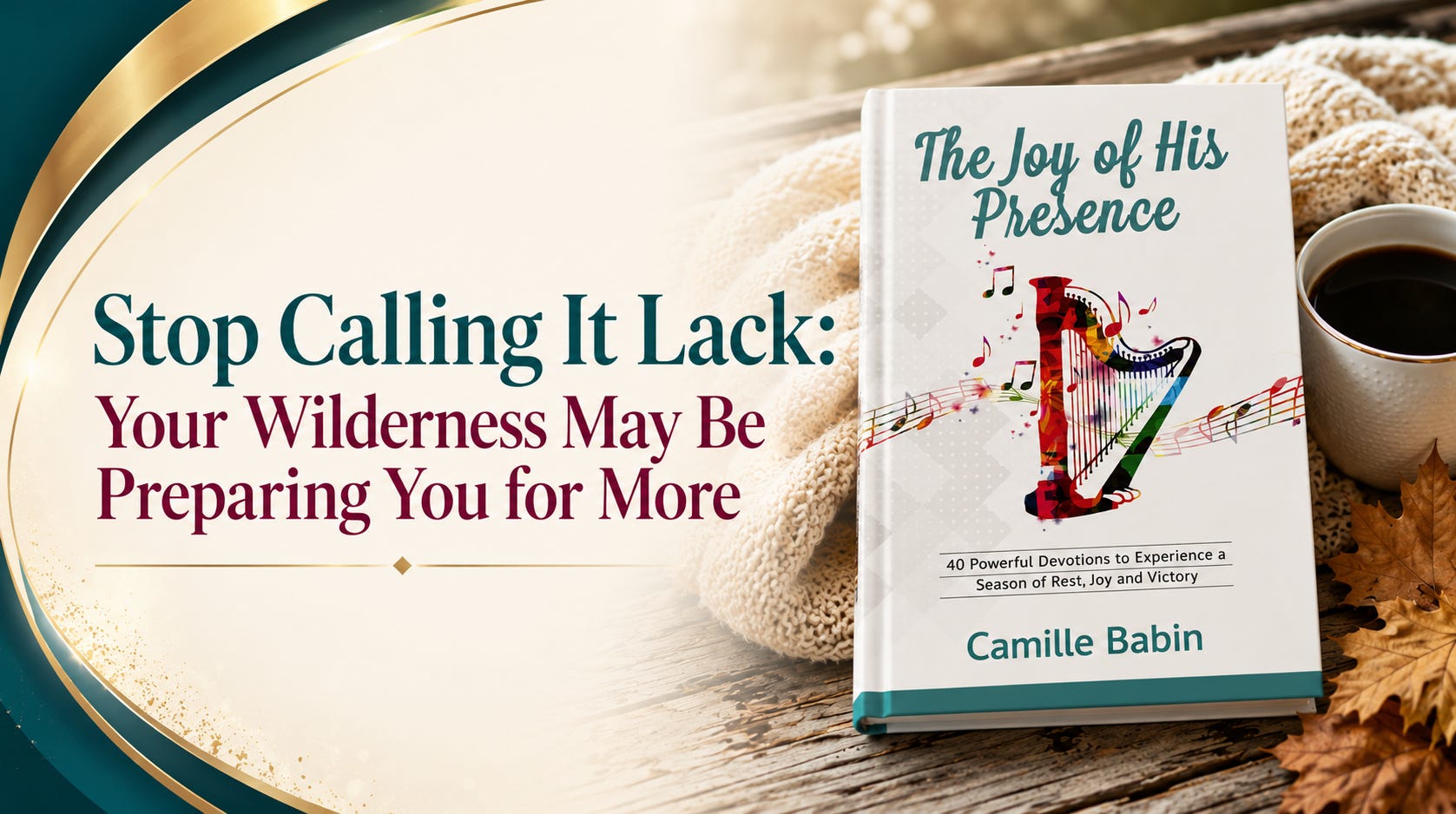
Your Wilderness May Be Preparing You for More
There are seasons when life does not look anything like what we expected. You are praying, you know God, and you are doing your best to remain faithful, yet somehow everything feels dry. The things that once brought excitement no longer move you. You keep showing up because you have responsibilities, people depending on you, and things that must be done, but inwardly you wonder how much longer you can continue.
I know that place because I have lived there. During one of the heaviest seasons of my life, I felt emotionally exhausted, lonely, misunderstood, and deeply discouraged. I was functioning, but much of what I did felt mechanical. I could smile, work, care for my family, and continue with my responsibilities, but my heart was not in it. I felt as though I had been pushing things down for so long that there was simply no more room left inside of me to hide what I was feeling.
And in the middle of that season, God asked me to write a book aboutjoy.
I had already written books before, and at the time I was working on something centered around fighting. That made sense to me because fighting felt much closer to where I was emotionally. But the Holy Spirit redirected me and gave me something entirely different:The Joy of His Presence, a 40-day devotional centered on learning to experience the joy found in God’s presence. I remember how disconnected that assignment seemed from my reality because there was nothing about that season that felt joyful. Yet as I began writing, one day at a time, I eventually understood that God was not asking me to write about how I felt. He was showing me where He was taking me.
That realization began changing the way I understood wilderness seasons.
The Wilderness Is Not Proof That God Has Abandoned You
When we find ourselves in difficult seasons, it is easy to evaluate everything according to what is missing. We look at what we lost, what has not happened, what God has not answered, what we thought would be different by now, and how far our current reality seems from what He promised. Without realizing it, we can develop an entire language around what is wrong.
As I was writingThe Joy of His Presence, the Lord began drawing my attention to the Israelites in the wilderness. They had been delivered from Egypt, but their language still sounded like Egypt. They murmured and complained. They constantly looked backward and remembered what they had left behind instead of becoming curious about what God had placed ahead of them. Their location had changed, but there were still things within them that needed to change before they could fully embrace where God was taking them.
That is when I began recognizing myself in their story. My circumstances were different, but my posture was not. I was so focused on what was wrong that I was struggling to see what God might be doing through the season. Sometimes the wilderness is not simply something we need God to get usout of. There are things He may need to getout of usbefore we enter what is next.
You Cannot Enter New Territory Speaking an Old Language
Israel had lived under slavery for generations. That environment had shaped the way they thought, responded, spoke, and interpreted hardship. Freedom changed their physical location, but transformation required a process. They had left Egypt, but God was also working to remove Egypt from them.
I believe the same can happen to us. We ask God for new territory while still carrying the fears, assumptions, reactions, survival patterns, and language of an old season. We want the promise, but we may not yet have the capacity to steward what the promise requires.
Perhaps that is one of the purposes of the wilderness. Instead of constantly asking,What am I losing?we begin asking,Lord, what are You teaching me? What needs to change in me before I arrive? What do I need to learn here that I will need there? What capacity are You developing in me now?
What if, instead of only asking God to shorten the wilderness, we also asked Him to make sure we do not leave it unchanged?
There came a point during that season when my husband and I had to confront our own posture. We realized that we had been complaining in ways that were not very different from the Israelites. We repented and made a decision that we were not going to keep cursing the very season God might be using to prepare us. Interestingly, our circumstances did not immediately change, butwe changed within the circumstances. Our posture shifted. Instead of constantly focusing on what was missing, we began asking God how He wanted to use the season.
That distinction matters because transformation is not always an escape route. Sometimes God changes you before He changes what is around you.
Don’t Curse the Season That Is Building Your Capacity
We often pray for increase without considering the capacity required to sustain it. We ask God for greater assignments, greater influence, greater resources, greater opportunities, and greater responsibility, but all of those things require something from us.
Greater assignments require greater endurance. Greater influence requires greater maturity. Greater responsibility requires greater wisdom. Greater capacity requires deeper dependence on God. What feels like an empty season may actually be a season in which God is making room in you. What feels like deprivation may be preparation. What feels like nothing is happening may actually be a refining process that is strengthening you so you can sustain what you have been asking Him to give you.
That is why I have learned to be careful about calling every uncomfortable seasonlack. Sometimes what looks empty from our perspective is full of activity from God’s perspective. We simply cannot see all of it yet.
Acknowledge What You Feel Without Allowing It to Lead You
There was another lesson God taught me during that season that I believe is equally important. Faith does not require us to pretend.
Sometimes, particularly as believers, we can become so determined to speak faith that we refuse to acknowledge what is actually happening within us. We are hurting, but say we are fine. We feel rejected, lonely, disappointed, angry, afraid, or exhausted, but we believe acknowledging those feelings somehow gives them power.
I do not believe we need to deny our emotions. We need to understand them and learn how to submit them to God. David demonstrated this beautifully when he asked his own soul why it was downcast and then directed it to hope in God. He acknowledged what was happening within him, but he did not allow what he felt to become the final authority over his life.
There is a difference between saying,“I feel rejected,”and deciding,“I am rejected.”There is a difference between experiencing loneliness and making loneliness your identity. There is a difference between recognizing fear and allowing fear to make your decisions.
Acknowledging what we feel gives us the opportunity to bring those feelings before God and confront them with truth. I may feel rejected, but God says I am chosen. I may feel alone, but God says He will never leave me nor forsake me. I may feel defeated, but His Word tells me that I am more than a conqueror. I may not see the way forward, but I can still trust the One who does.
We are not using Scripture to pretend the pain does not exist. We are allowing truth to determine what gets the final word.
Perhaps You Are Not Lacking. Perhaps You Are Being Prepared.
If you are walking through a wilderness season right now, I want to encourage you to be careful about interpreting everything through the language of lack. You may look around and see what is not happening, while God sees what is being developed. You may see delay while He sees preparation. You may see emptiness while He sees newly created capacity. You may see a wilderness while He sees the training ground for your next assignment.
So perhaps the question is not only,“God, when are You getting me out of here?”Perhaps there are other questions worth asking:“God, what are You trying to put in me while I am here? What needs to leave me? What language needs to change? What are You teaching me to depend on You for? What strength, wisdom, discipline, or endurance will I need for where You are taking me?”
The wilderness is not necessarily evidence that the promise has been withdrawn. Sometimesthe wilderness is where God prepares us to carry the promise without being crushed by the weight of it.
That was ultimately the lesson God was teaching me when He asked me to write The Joy of His Presence during one of the least joyful seasons of my life. He was not asking me to deny where I was or pretend that what I felt was not real. He was teaching me where to look while I was there.
Sometimes we become so focused on getting out of the wilderness that we miss the God who is present with us in it. Yet that may be where the greatest transformation takes place, because even in the wilderness, His presence is available.
And in His presence, there is fullness of joy.