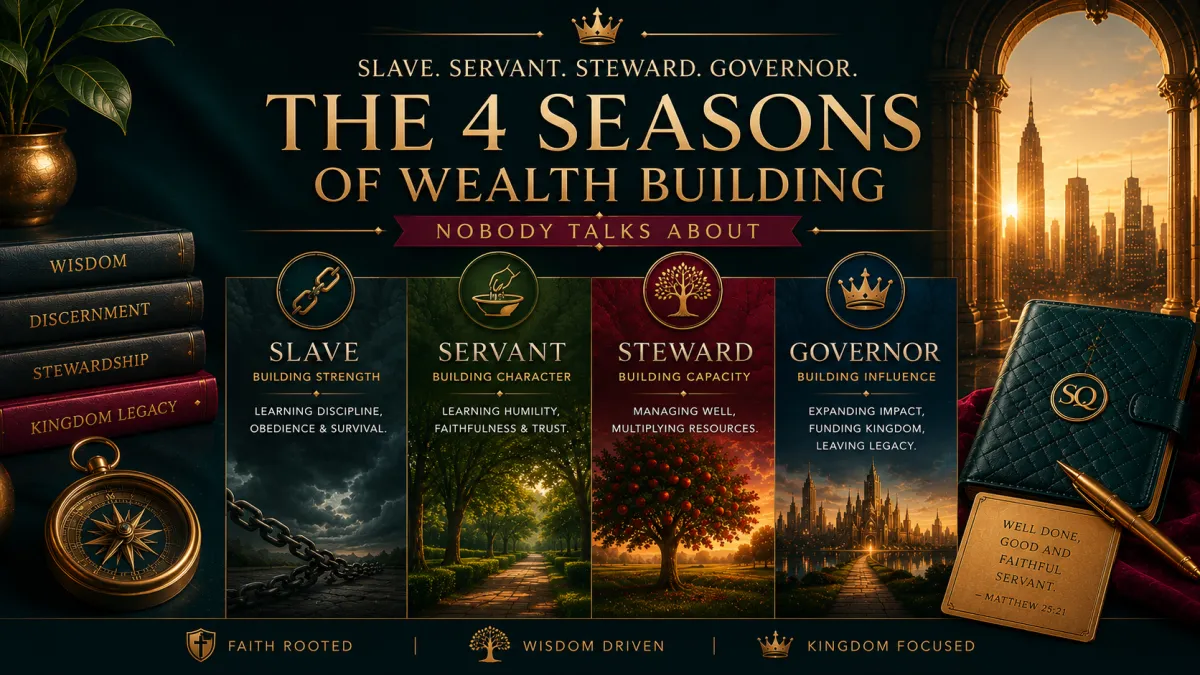
Slave. Servant. Steward. Governor. The Four Seasons of Wealth Building Nobody Talks About
Last week we talked about the financial freedom lie, the idea that escaping the rat race is the destination, when really it’s just the doorway.
This week I want to go deeper into something I touched on, the place where Kiyosaki’s Cashflow Quadrant stops short.
Because here’s a man who started with nothing.
No inheritance. No connections. No capital. No mentor to explain assets and liabilities. No network, at least not one working in his favor. In fact, the people who should have been his network sold him into slavery.
And by the time his story ends, this man controls the economy of the most powerful nation on earth. He saves millions of lives. He positions his family for generational wealth. And he does it without compromising, not once, the values that defined him from the beginning.
His name is Joseph. And I want to read his story differently than you’ve heard it before.
Kiyosaki’s quadrant describes what people do to earn income, Employee, Self-Employed, Business Owner, Investor. It’s a brilliant framework for moving from labor to leverage, from dependency to ownership.
But Joseph’s story describes something deeper: who people become through each season. And that’s a different conversation entirely.
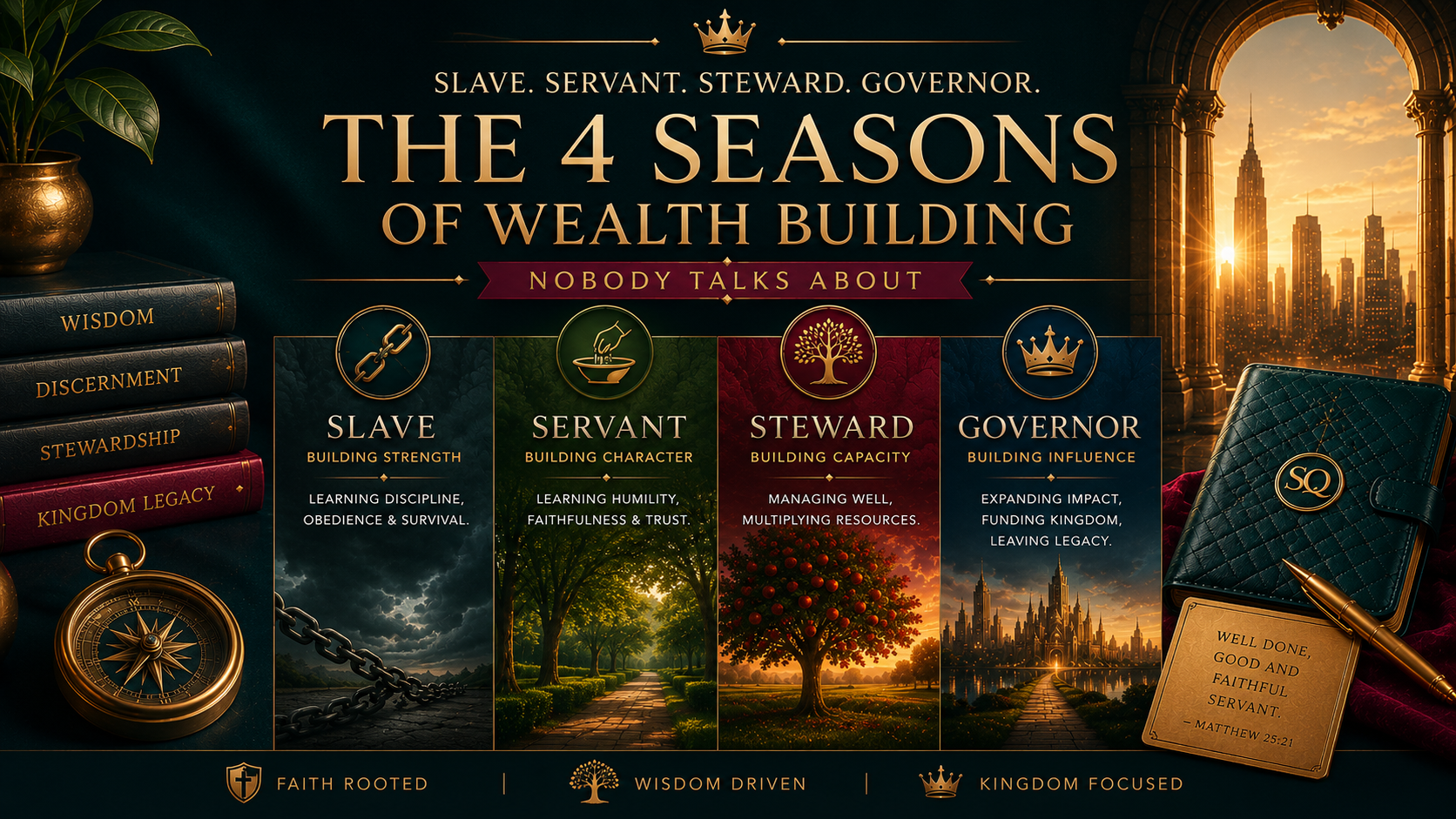
So here’s the framework underneath the framework. Four roles, not four income types, four roles of becoming.
Slave. Bound, no agency, serving someone else’s agenda. Financially, this is when debt owns you. When the money is already spoken for before it arrives. When you’re working hard and still can’t get ahead, and the shame is too heavy to even pray about.
Joseph arrives in Egypt as property. No title, no ownership, no freedom by any definition. And yet Scripture says the Lord was with him, and he became successful in his master’s house. The presence of God was producing success inside the constraint.
The principle: you don’t wait until you’re free to operate with excellence. You bring your full anointing into the most constrained environment, because excellence in the small prepares you for authority in the large.
Servant. Still in someone else’s house, but something shifts internally. You’re not serving because you have no choice, you’re serving because faithfulness has become its own reward.
Joseph becomes so present in his service that Potiphar stops managing him altogether. Financially, this looks like steady employment, tithing from the little, paying down debt one payment at a time. You’re not building yet, you’re developing the character building will require.
The temptation here is to rush it. To look at the next season and think you should already be there. But the Servant season isn’t a detour. It’s development.
Steward. Then everything falls apart. Joseph is falsely accused and imprisoned. He did everything right and ended up in a cell.
But in prison, he’s given autonomous responsibility. He runs the operation. This is the Steward season, learning to manage what you didn’t earn, in environments you didn’t choose.
Financially, this is cash flow that isn’t yours, it belongs to God. A business, a team, a client base, and the weight of it humbles you instead of inflating you. You’re building systems, pricing confidently, surrounding yourself with people who help you manage what’s been entrusted to you.
The principle: stewardship isn’t about how much you have. It’s about what you do with what’s in your hands, and whether you hold it open or clutch it closed.
Governor. After the famine, after the reunion, Joseph settles his family in the best land in Egypt. Genesis says they gained possessions there, the Hebrew word is achaz, to seize, to hold, to acquire as an inheritance.
This season isn’t about income or even wealth as we typically define it. It’s about legacy. Decisions made today that provide shade for trees you’ll never sit under. An estate plan, a trust, generational wealth vehicles, not because you’re rich, but because you’re responsible.
And here’s the distinction that matters most: Kiyosaki’s Investor quadrant is about personal financial freedom, your money works so you don’t have to. Joseph’s Governor season is about generational kingdom positioning, building so the people God assigned to you can stand on what you built and go further than you ever could.
One is for you. The other is for the people God put in your path.
So here’s my question: what do you do when the pit is part of the plan? What does financial intelligence offer the woman carrying a prophetic word about where she’s going, while living in a reality that looks like the exact opposite?
Here’s what Joseph had that no framework can give you. He had an identity that wasn’t contingent on his role. In the pit, he was still Joseph. In the palace, he was still Joseph. He never confused his assignment with his address.
You don’t graduate from one season to the next by earning more money. You graduate by developing the character the next role requires. God will never release Governor-level resources to someone who still has a Slave-level identity.
The money was never the issue. The identity was.
Wherever you are right now, slave, servant, steward, or approaching governor, don’t despise the season you’re in. Mine it. Learn it. Master it. Because Joseph didn’t arrive at the palace in spite of the pit. He arrived because of what the pit produced in him.
Your constraint is curriculum. Your delay is development. Your pit has a purpose.
This week’s podcast goes deeper into all four seasons. If you’re ready to move from surviving your season to stewarding it well, that’s exactly the work we do inside Fix My Piggy Bank.