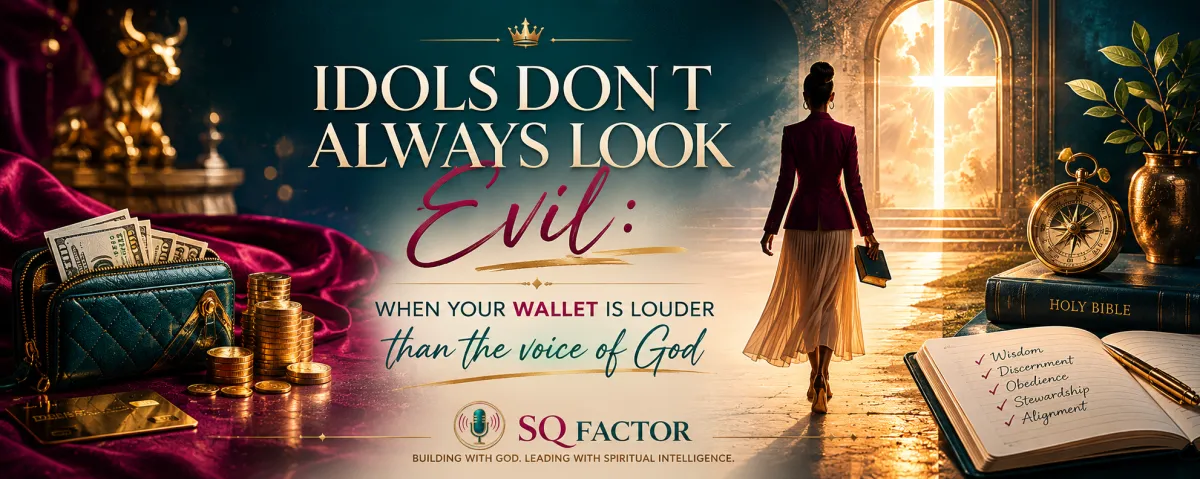
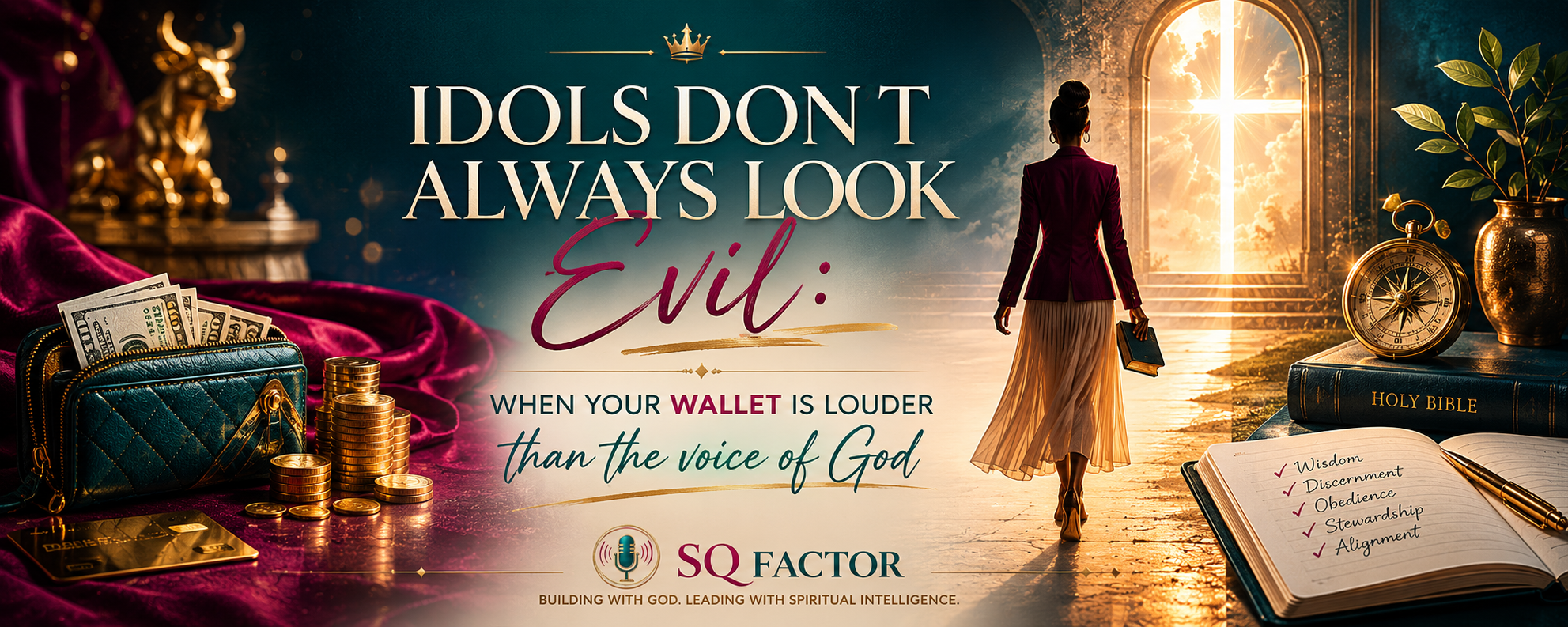
Idols don’t always look evil: when your wallet is louder than the voice of God
A few years ago, God said something to me that impacted me deeply. He said: "Camille, if every time you have to decide whether to do something, your first move is to check your bank account, then you trust money more than you trust Me.” Ouch! I didn’t see this coming!
I was doing what I thought responsible, faithful women do: I was being practical. But God wasn’t calling me out. Because what looked like wisdom was actually a silent form of bondage.
Idols don’t always look evil.
That’s the thing nobody tells you. We have this picture in our minds of what an idol looks like — something grotesque, something obviously wrong. A golden calf. A statue or a blatant false god.
But real idolatry is rarely that visible. Real idolatry is subtle. It sometimes looks respectable. It wears the right clothes and uses the right language. It goes to church. It tithes. It creates budgets.
And then it makes decisions that God was never invited into.
The rich young ruler — the man we explored in Part 1 of this series — didn’t have a grotesque idol. He had a respectable one. His wealth looked like security. Like the fruit of a righteous life. Like something God had clearly blessed. And that’s exactly why he couldn’t release it when Jesus asked.
Because the thing he was holding feltmore solidthan the voice asking him to let go.
Money doesn’t have to be your god for it to be your oracle.
An oracle is what you consult when you need direction. It’s the first voice you go to. And for many of us, even those of us who are faithful, who love God, who are doing the work, money has suddenly become the oracle we consult before we ever bring the question to God.
There are two directions this happens. And most of us only recognize one.
When we can’t afford something,we don’t pray about it. We don’t seek God. The account looked at us and said no, and we accepted that as the final word. We called it being responsible. We called it wisdom.
But sometimes, if we’re honest, we called it wisdom when it was really fear. We used financial reasoning as spiritual cover for not trusting God.
When we can afford something. This one is sneakier. When the money says yes, we proceed. We don’t ask if it’s the right timing. We don’t ask if God is in it. The wallet gave us permission, and that was enough.
Think about that. In both cases, whether you have it or you don’t, God wasn’t consulted. Money made the call.
That is an oracle. And that is an altar that most of us have been visiting for years without knowing it had a name.
The boxes we check
The rich young ruler came to Jesus with a list. He had kept the commandments. He had honored his parents. He had not murdered, not stolen, not borne false witness.
Checked. Checked. Checked. And yet, when Jesus looked at him with love and gave him one instruction, the man walked away grieved. Because the instruction revealed what was actually sitting on the throne of his heart.
I want to ask you something, and I want you to answer honestly: What are the boxes you’re checking that are making you feel more surrendered than you actually are?
Many of us tithe — check. We give — check. We pray about some things — check.
But there is a category of decisions, usually financial, usually significant, where God is welcome in the outcome, but not the process. Where we’ve already decided what’s possible based on what the numbers say. Where the money gets the first word, and God gets to bless whatever we decided.
That’s where the idol lives.
When God gave me that word —you trust money more than you trust Me— my first instinct was to defend myself. But I’m being responsible. I’m being wise. This is what good stewardship looks like. And what I felt Him say was: Seek Me First (Matt.6:33)
I realized I had entire categories of my life where I hadn’t asked God. The account said yes — I said yes. The account said no — I said no. And God was invited to agree. Not to lead. To agree.
That is not stewardship. That is functional atheism wearing the language of faith.
What has your wallet said no to, that you never bothered to ask God about?
What has your wallet said yes to, that God was never consulted on?
Those are your altars. The ones you built in the name of being responsible.
True stewardship doesn’t begin with your account balance. It begins with a question: God, what do You want to do with what You’ve entrusted to me?
Everything else is just math.
This is Part 2 of the Rich Young Ruler series. Listen to the full conversation on The SQ Factor podcast
Share it with someone you know who needs to read it.
— Camille
SQ Factor | Spiritual Intelligence · Wealth · Leadership · Stewardship