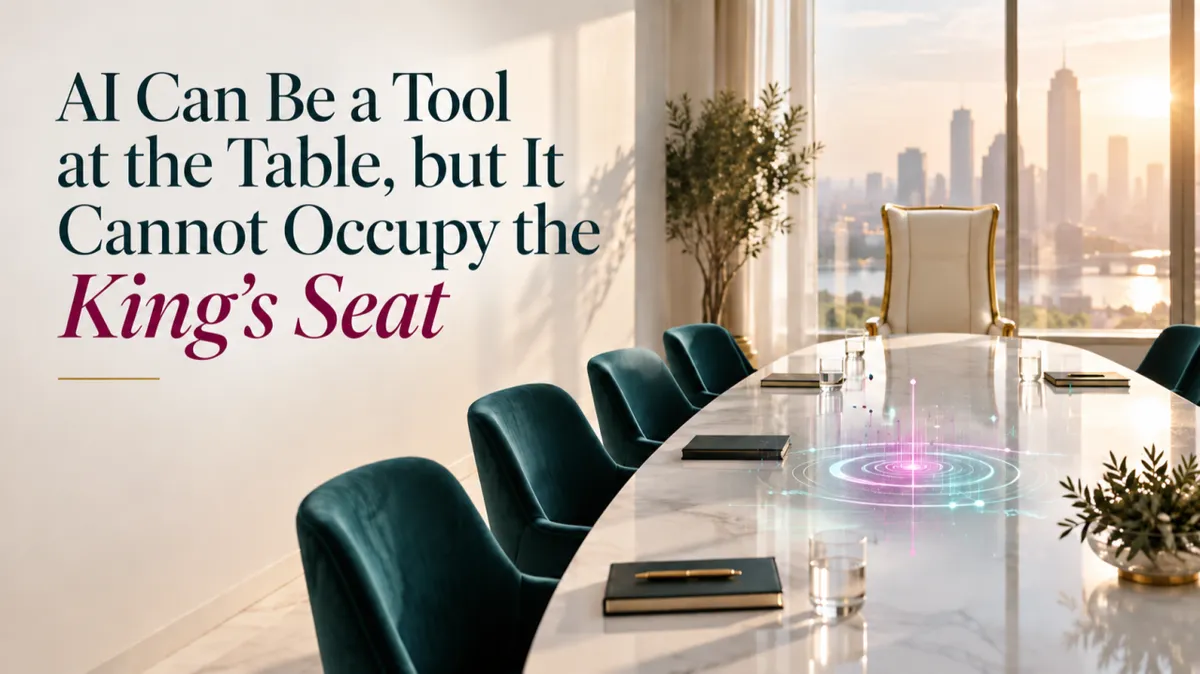
AI Can Be a Tool at the Table, but It Cannot Occupy the King’s Seat
This morning, I reviewed a collection of courses about using AI at work. Some focused on delegating routine tasks, while others addressed fact-checking, analyzing data, building AI agents and knowing when AI should not be used. As I reviewed them, I began thinking about the place we give AI in our businesses and decisions.
AI can be a tool at the table, but it cannot occupy the King’s seat.
I use AI, and I believe it can be incredibly valuable. It can gather information, identify patterns, organize scattered ideas and help us consider possibilities we may not have seen. It can prepare reports, compare options, summarize meetings and turn hours of administrative work into minutes. However, the more capable AI becomes, the more important it is to consider the level of authority we are giving it.
When a tool becomes an authority
There is a difference between using AI to inform a decision and allowing it to make the decision for us.
A spreadsheet can tell us whether an opportunity appears profitable. Market data can show us where demand is increasing. AI can analyze trends, generate projections and recommend what appears to be the most efficient path, but it cannot tell us whether God authorized that path.
It cannot tell us whether a profitable opportunity will pull us away from our assignment or discern whether this is the season to expand, wait, prune, release or walk away. It cannot determine whether the person who looks perfect on paper is the person God intends to join the organization. It also cannot recognize when obedience requires something that appears strategically unreasonable.
AI can process information, but it cannot replace discernment.
The danger is that we gradually stop seeking God because the tool gives us answers faster. We can become so impressed by what AI knows that we forget what it cannot know.
AI does not know the counsel of God. It is not responsible for the consequences of our decisions, nor can it repent when it is wrong. It does not bear the spiritual responsibility for the organizations, people and assignments entrusted to us, and it will not stand before God to give an account for how we led. We will.
That is why faith-driven leaders must remain careful about the seat we give technology in our decision-making. AI, data, advisors, consultants, financial projections and market research can all have a place at the table. They can inform us, challenge us and help us see more clearly, but none of them belongs in the King’s seat.
Intelligence is not the same as wisdom
We are living in a time when access to intelligence is expanding rapidly. We can ask a question and receive an answer in seconds. We can analyze more information than one person could ever review alone, produce faster, automate more and build things that once required entire teams. All of that has value, but greater intelligence does not automatically produce greater wisdom.
Intelligence can show us what is possible and help us understand how something could be accomplished. Wisdom helps us discern whether it is permissible, appropriate and aligned. It causes us to consider whether we should move, when we should move and whether what we are preparing to build is actually ours to build.
This is why spiritual intelligence matters. For the faith-driven leader, the goal cannot simply be to make increasingly intelligent decisions. The goal is to discern God’s perspective and respond with wisdom, character and obedience.
Sometimes that response will make excellent business sense. At other times, it may not make sense until much later. Our responsibility is to recognize what God is saying and have the courage to respond, even when another option appears more profitable, efficient or strategic.
Who is governing your use of AI?
The growing conversation around AI is often focused on regulation. Governments, companies and institutions are asking who should control it, what safeguards should exist and how misuse can be prevented. Those are necessary questions, but every leader must also consider who is governing their personal use of it.
Are you using AI from a place of clarity, or are you using it to avoid dealing with uncertainty? Are you asking it to support your stewardship, or have you unconsciously allowed it to relieve you of the responsibility to discern? Are you using it to organize what God has already instructed you to do, or has it become a source of endless strategies that keep you busy but unaligned?
We must also ask whether we are still bringing our decisions before God or whether speed and convenience have replaced seeking.
Recommendations may come from an algorithm, an advisor or our own reasoning. Regardless of the source, we must examine whether we have made God the consultant to the business instead of King over it.
Keeping the seats in order
Faith-driven leaders do not need to fear AI. We need to understand it, use it wisely and remain aware of both its possibilities and its limitations.
Let AI research, organize, calculate and help you prepare. Let it reveal options you may not have considered. Then bring those options before God, seek His perspective, test what you have received and verify the information. Pay attention to what brings clarity and what creates unease.
We must remain willing to reject the most intelligent recommendation in the room when it conflicts with the instruction of the King.
AI may become one of the most useful tools we have ever been given, and it deserves a place at the table. But it cannot occupy the King’s seat.
If you are learning how to seek God’s perspective in the practical decisions of business and leadership, I invite you to join us inside The Kingdom C-Suite Community.
This is a community for faith-driven leaders who want to move beyond believing that God belongs in business and develop practical ways of recognizing and responding to His counsel in how they build, decide and lead.
Inside the community, we will examine the different seats within the organization, the decisions attached to them and what changes when God is acknowledged as King over the entire operation. The doors open October 22.